Thought Leadership

This edition ISO Insights was originally released in March 2026. To receive editions of Nira Energy's ISO Insights as they release, request access to our newsletter today.
MISO South DPP 2025: ERIS vs. NRIS Cost Structure Analysis
March 2026 • Carlos Toledo, Transmission Planning Engineer
MISO’s final DPP 2025 Phase 1 results were released on March 24th, and Nira's team flagged a striking data point: 76% of MISO South's network upgrade costs are ERIS. Only 24% are NRIS. In MISO Classic (Central, West, ATC, ITC), the split runs in the opposite direction — 16% ERIS, 84% NRIS.
That's not how interconnection costs typically work. NRIS usually dominates because deliverability requires deeper network reinforcement. In South, the grid is so congested that most overloads are caught before the deliverability study even runs. Nira Energy Transmission Planning Engineer Carlos Toledo, breaks down the shift in upgrade costs below.
The Pattern Across Cycles
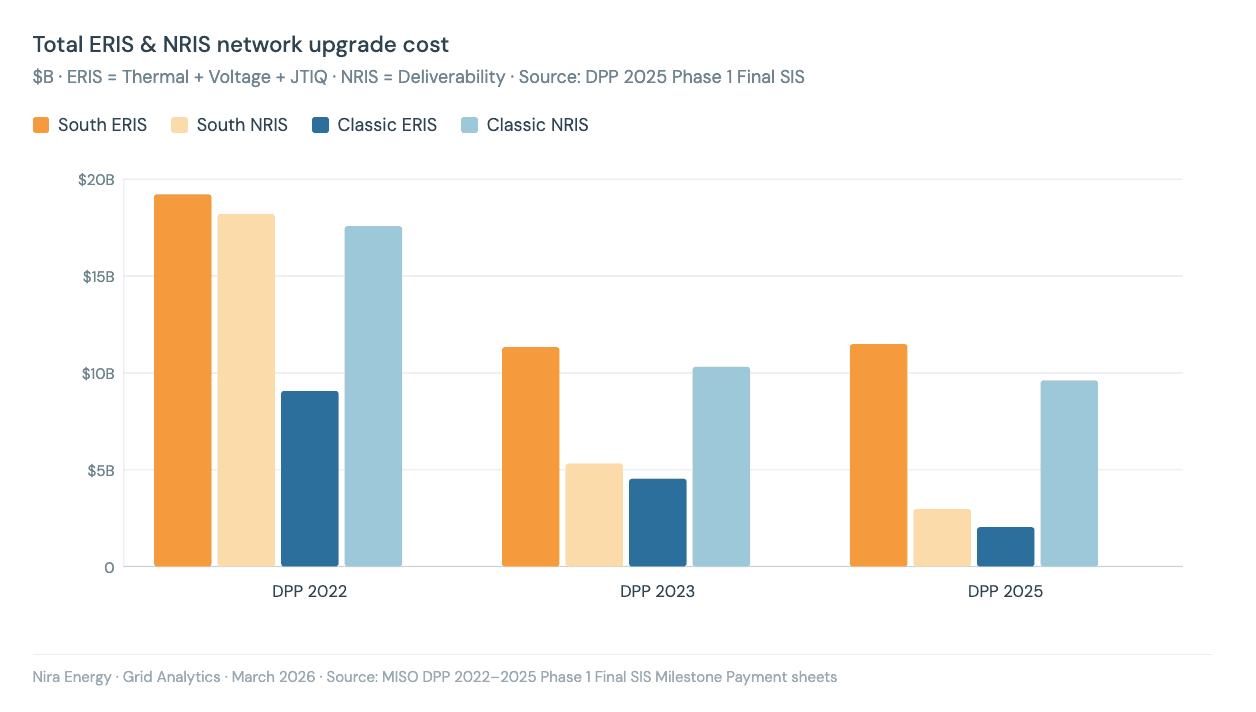
This inversion has been compounding since DPP 2022:
DPP 2022: South ERIS = 51% of total NU cost ($19.2B of $37.4B)
DPP 2023: South ERIS = 68% ($11.3B of $16.6B)
DPP 2025: South ERIS = 76% ($11.5B of $15.2B)
Classic has moved in the opposite direction — from 34% ERIS down to 16% — driven likely by ~$32B in LRTP Tranche 1 and 2 investment. South has received zero LRTP funding to date.
The Root Cause: The 500kV Backbone
The El Dorado, Sheridan, Franklin, and McKnight 500kV corridors are at capacity. Every new MW of interconnection request injection overloads dozens of parallel paths.
The updated study identified 355 overloaded transmission elements in South — down from 449 in the preliminary February results, reflecting two MTEP25 reliability projects on the 500 kV backbone and finalized DPP 2021 South Phase 3 network upgrades now modeled in the base case. Even with that reduction, South's overloaded element count remains more than 3x that of all Classic combined (107).
Cost per MW reflects three cycles of compounding congestion:
• South ERIS $/MW: $335K (DPP 2022) → $581K (DPP 2023) → $929K (DPP 2025)
• Classic ERIS $/MW: $108K (DPP 2022) → $37K (DPP 2025)
That's a 25:1 ratio. High costs drive 60–76% of South projects to withdraw. Their allocated upgrades go unfunded, and the grid stays congested. The next cycle encounters the same constraints. MISO runs the ERIS thermal study first, so with the 500kV backbone already near capacity, most overloads are caught at that stage. By the time the NRIS deliverability study runs, ERIS upgrades are assumed in place and far fewer additional violations surface. Projects that advance past Phase 1 also frequently reduce or drop their NRIS requests to lower milestone payments, further shrinking the NRIS pool.
LRTP Tranche 3 targets South, but only began planning in 2025.
How Nira Energy is Helping Teams Navigate This
Nira's In-Queue MISO platform gives developers early visibility into upgrade exposure and scenario outcomes across every active study phase. For teams with projects already in the queue, this means:
Phase 2 and Phase 3 cost previews — our methodology has historically aligned within three percentage points of MISO's final results, giving developers confidence to make withdrawal, downsize, or investment decisions before official postings.
Dropoff and withdrawal scenario testing — model how costs shift as other projects leave the queue. In South, where 60–76% of projects withdraw, understanding how your allocation changes under different attrition scenarios is critical.
Upgrade cost forecasting — identify which network upgrades drive your cost allocation, and how those same 500kV corridors we tracked above affect your specific project.
For teams still siting, Nira's Prospecting platform models constraint exposure at the bus level — showing which injection points carry the least congestion risk before you enter the queue. In a region where ERIS cost per MW ranges from under $100K to over $5M depending on location, where you interconnect matters enormously.
If you're evaluating MISO South projects or preparing for upcoming decision points, reach out to our team. We can help you navigate rapidly shifting cost landscape with accuracy.