Thought Leadership
Authored By: Emily Moini, Product Manager at Nira Energy
The landscape for connecting large loads in the Southwest Power Pool is changing rapidly. In 2024 alone, nearly 6 GW of large loads—primarily AI datacenters—requested to connect in SPP (SPP 2025). The existing interconnection framework simply wasn't designed to handle this volume or timeline pressure. Developers need faster, more reliable pathways to "plug in" both new loads and new generation.
SPP has responded with comprehensive reforms under their High Impact Large Load (HILL) framework, introducing new processes that fundamentally reshape how loads and co-located generation connect to the grid. At Nira Energy, we're closely following these changes and are ready to help you navigate this new terrain—whether you're developing load, co-located generation, or both.
The Problem: Too Much Demand, Not Enough Capacity
The surge in datacenter development has exposed critical limitations in SPP's traditional large load interconnection processes. The unprecedented volume of load interconnection requests is creating a resource adequacy challenge— insufficient generating capacity on the grid to serve the anticipated load demand.
The gap between SPP’s Anticipated Reserve Margin and the Planning Reserve Margin (19%) is forecasted to steadily decline over the next 5 years:
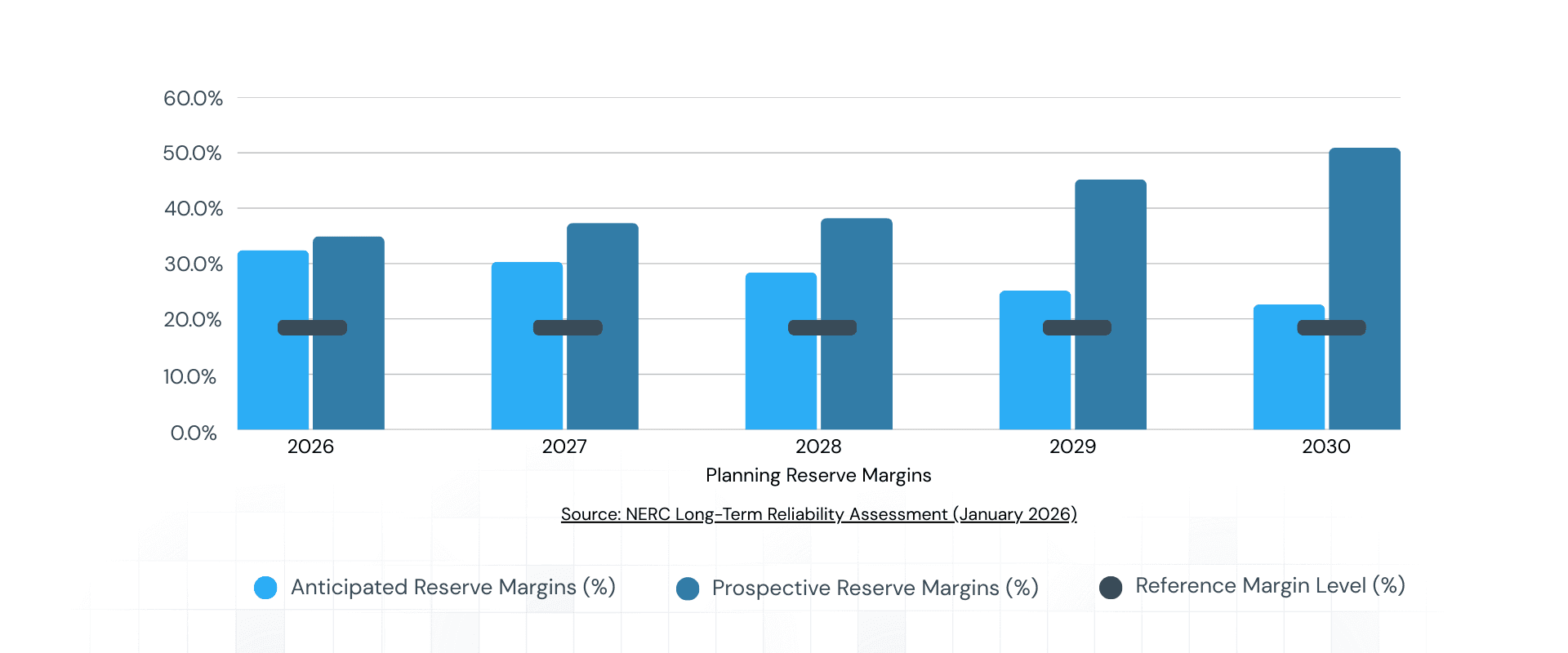
Source: NERC Long-Term Reliability Assessment (January 2026).
SPP's existing interconnection processes weren't built for the current moment. The surge in datacenter development, combined with mounting resource adequacy concerns, created an urgent need for faster pathways to connect both large loads and generation in SPP:
The old Delivery Point Assessment (Attachment AQ) process required projects to rely on existing Designated Resources (generation) that had already completed the Network Integration Transmission Service (NITS) process.
Meanwhile, the traditional generator interconnection queue process (Attachment V) moves too slowly to get requisite generation online in time to meet datacenter developers' aggressive timelines.
HILL Process: Three New Pathways
SPP's HILL reforms introduce a more flexible framework with three distinct pathways for connecting large loads:
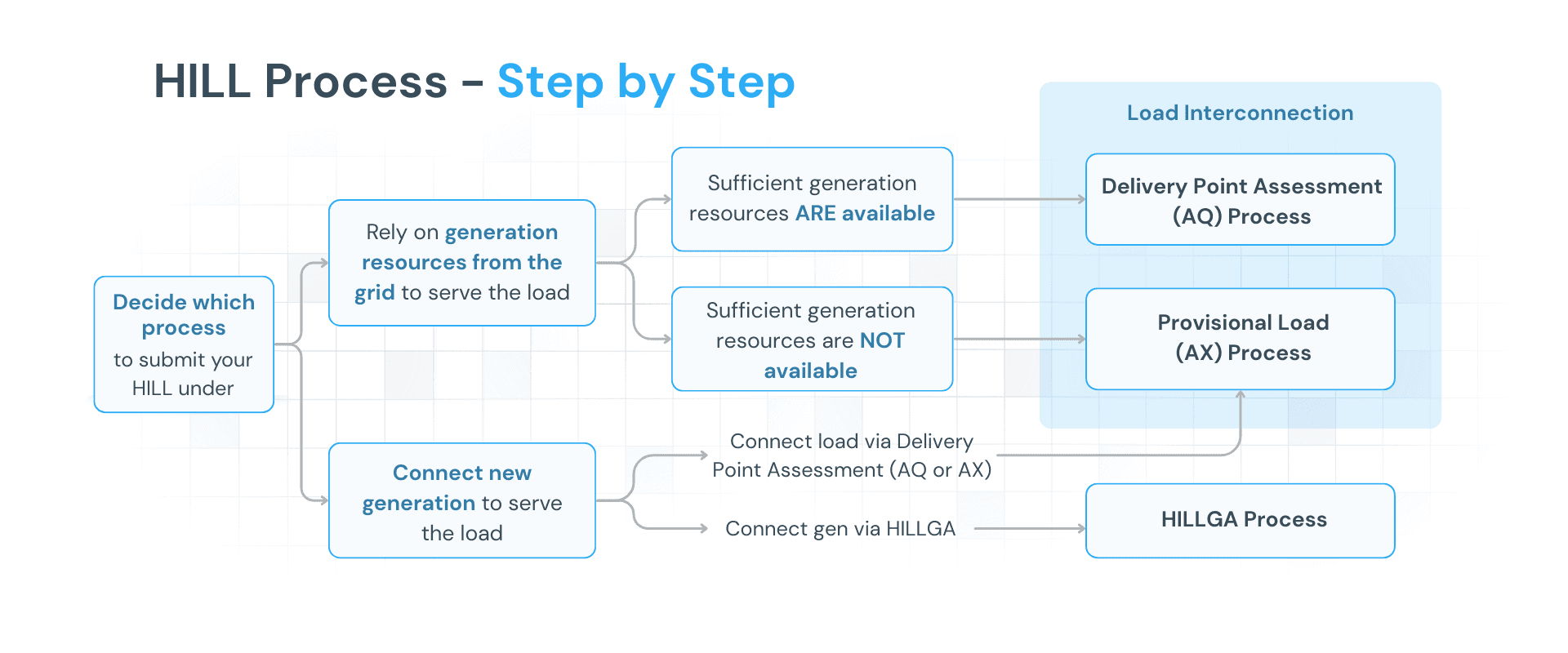
1. [Existing; Reformed] Delivery Point Assessment (Attachment AQ) Process
The traditional AQ process remains available for projects that can rely on existing designated generating resources. Under the HILL framework, these projects now go through a High Impact Large Load Delivery Point Study (HDPS) conducted by SPP, alongside the host transmission owner's Local Connection Study (LCS). Additionally, under the HILL reforms, SPP is committed to running through the AQ study process within 90 days of study agreement execution. (SPP RR 696 Recommendation Report)
2. [New] Provisional Load (Attachment AX) Process
This is the game-changer for projects that are seeking a grid conection but for which the Transmission Customer (i.e. the utility) does not have sufficient Designated Resources. The AX process allows SPP to factor in planned generation when studying your load interconnection.
Under AX, SPP will run a new study process (HDPS - HILL Delivery Point Study) using their Integrated Transmission Planning (ITP) models, incorporating both the Designated Resources outlined to support the 10-year load forecast at your proposed delivery point, as well as additional planned generation in the area. (The host transmission owner will simultaneously run a Load Connection Study (LCS) to study your large load.)
Large loads studied under the AX process will receive transmission service only once those planned generation resources obtain Designated Resource status. This new AX process opens the door for large loads to be powered via a grid connection that would otherwise have required behind-the-meter (BTM) generation to achieve desired energization timelines.
3. [New] HILLGA
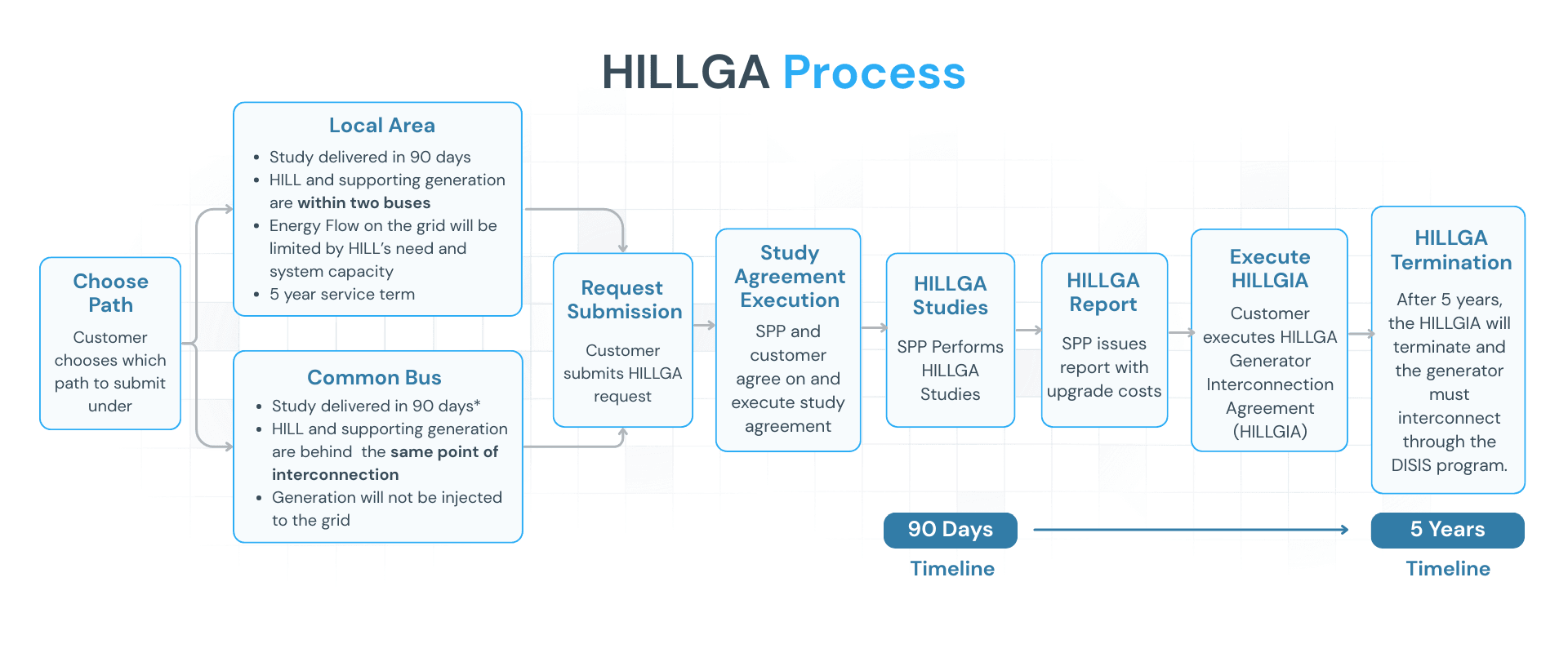
For generation projects colocated near one or more large loads, HILLGA allows you to obtain an interconnection agreement (HILLGIA) to connect the generator with significantly faster study timelines (90 days).
Under the new HILL process, your generation and load are studied through separate processes— the load through either the AQ or AX process, and the generator through a new process called HILLGA.
HILLGA offers two separate interconnection paths:
Common bus: Load and generation share the same point of interconnection
Local area: Load and generation are within two buses of each other
Generators interconnected under HILLGA receive "Load Limited Resource Interconnection Service" (LLRIS), meaning their maximum output cannot exceed the supporting load's forecast. Additionally, after five years, the HILLGA agreement terminates and the generator must secure a new interconnection agreement through the DISIS process (the standard generator interconnection process in SPP).
Source: NERC Large Loads Task Force Meeting (September 2025)
How HILL Reforms are Reshaping Site Selection in SPP
SPP's HILL reforms don't just change how loads and generators connect — they change what information you need to make informed siting decisions.
If you're a generation developer: The creation of HILLGA means it's no longer enough to look only at injection capacity when prospecting for new sites. You now need to put on your large load developer hat and ask: where are the optimal locations to interconnect large loads? Those are the sites where HILLGA opportunities will emerge. Reviewing withdrawal capacity across an entire ISO footprint— which Nira provides through our Large Load Prospecting Heatmap— can help you identify the most attractive areas for new large load development. Such pockets may therefore present opportunities to colocate generation via HILLGA.
If you're developing both: If you’re developing a fully co-located load and generation project, both dimensions of capacity are essential inputs to your site selection process. You need withdrawal capacity to identify where your load can connect, and injection capacity to understand the opportunity cost of forgoing pure generation development in a given region in exchange for pursuing colocation under HILLGA terms.
How Nira Energy Can Help
At Nira, we specialize in providing datacenter developers with utility-grade analysis of transmission capacity and interconnection opportunities. As SPP implements these HILL reforms, we're building the tools you need to navigate the evolving interconnection landscape.
We help you:
Identify optimal connection points by analyzing both withdrawal and injection capacity across the SPP footprint
Evaluate which process pathway (AQ, AX, or HILLGA) makes sense for your specific project and timeline based on forecasted injection and withdrawal estimates
Track ongoing regulatory changes as SPP continues to refine these processes—we monitor tariff updates, study methodology changes, and transmission owner adaptations to their Local Criteria Studies
Whether you're developing load, co-located generation, or exploring both options, Nira is here to support you in navigating these new processes. We provide the clarity you need to make informed site selection decisions in this rapidly changing environment.
Looking Ahead
Load interconnection reforms aren't limited to SPP. PJM has introduced a fast-track interconnection pathway for large loads, and ERCOT has implemented a Batch Study Process for managing the huge spike in large load interconnection requests from datacenters. Nira is tracking these changes across all major ISOs and providing the most comprehensive analysis of available capacity and interconnection opportunities in each region.
In this evolving interconnection policy landscape, success now requires understanding the interplay between loads, generators, and multiple interconnection pathways. If you're planning projects in SPP or other markets, reach out to our team to learn how we can support your site selection process.
Want to dive deeper into understanding transmission capacity in SPP or explore opportunities in other ISOs? Contact Nira Energy to see how our transmission capacity analysis can accelerate your datacenter development timeline.