Product Announcement

PJM

Gain Competitive Clarity with Study Projects

As the April 27, 2026 deadline for PJM Cycle 1 approaches, developers are preparing submission decisions in a cycle that includes both legacy and newly queued projects. Analyzing specific cluster composition will be critical for developers seeking to de-risk their project.

By Nira Energy | Published February 2026
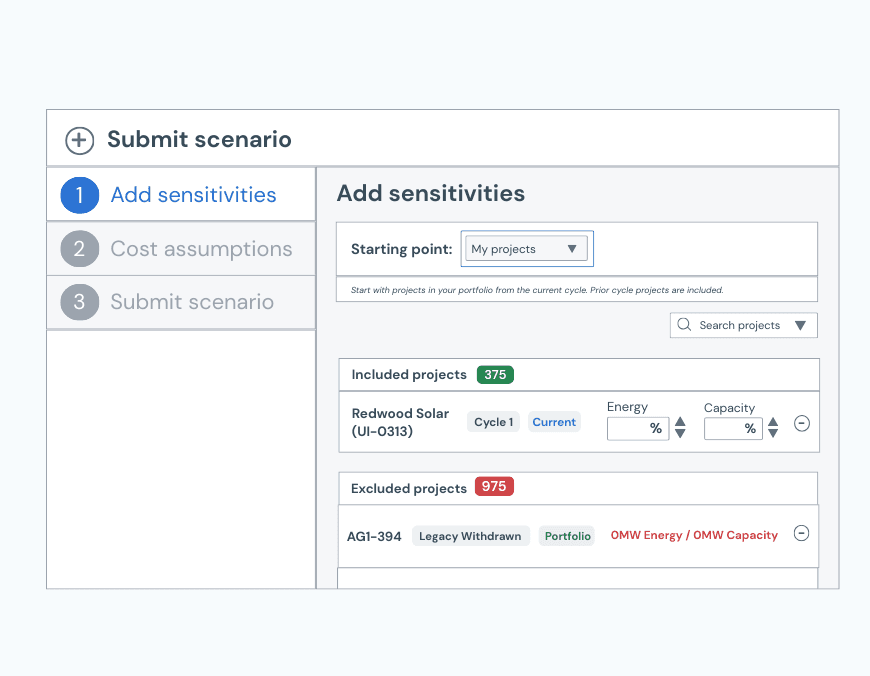
PJM Cycle 1 Study Projects

IQ Study Projects helps evaluate late-stage prospects before deciding whether or not to submit an interconnection request, by enabling users to create projects and add them into a shadow cluster study. User-defined project inputs include fuel type, project size (MFO/CIR), and POI (bus or line tap), and can be input based on internal siting strategy, proprietary research, or competitive awareness and evaluate its performance within PJM’s cluster structure.


Users are also able to add in Legacy projects that did not qualify for TC1 or TC2 but are now eligible to resubmit into Cycle 01. The composition of these Legacy submissions is known, providing users with greater awareness of impacts caused by potential cluster-mates.


Capabilities Include:

  • Cluster-based cost allocation

    Evaluate how upgrade costs distribute across the full cluster, including legacy projects, and estimate the portion attributable to the study project.

  • Custom sensitivity analysis

    Model alternative assumptions, including isolating TC1 or TC2 projects, adjusting attrition scenarios, or testing different cluster compositions.

  • Late-stage competitive assessment

    Analyze how a project performs relative to other cluster participants before deposits are committed.


Why It Matters


Legacy projects and cluster composition can materially influence upgrade triggers and cost allocation outcomes. Even small shifts in participant assumptions may change a project’s exposure to shared network upgrades.


Prior to submission, developers should understand:

  • The upgrades most likely to affect their project

  • How costs may be allocated under current cluster conditions

  • The sensitivity of those outcomes to attrition or participant changes

  • Whether project economics remain viable under reasonable scenario variations

  • The impact of multiple projects sited in a local area, both their own or competitive projects


Conducting sensitivity analysis on shortlisted sites provides greater confidence that submission decisions are grounded in study-aligned evaluation rather than directional estimates. The objective is to reduce late-stage uncertainty and improve capital discipline at the point of filing.


The Bottom Line

PJM Cycle 1 submission closes April 27, 2026.

While queue visibility has improved in this cycle, clarity regarding project-specific cost allocation remains essential.

Nira’s Study Projects tool enables developers to evaluate speculative submissions within PJM’s cluster study framework, assess cost allocation exposure, and test sensitivity assumptions before interconnection requests are submitted.

Interested in learning more? Schedule a Demo today.

Why It Matters


Legacy projects and cluster composition can materially influence upgrade triggers and cost allocation outcomes. Even small shifts in participant assumptions may change a project’s exposure to shared network upgrades.


Prior to submission, developers should understand:

  • The upgrades most likely to affect their project

  • How costs may be allocated under current cluster conditions

  • The sensitivity of those outcomes to attrition or participant changes

  • Whether project economics remain viable under reasonable scenario variations

  • The impact of multiple projects sited in a local area, both their own or competitive projects


Conducting sensitivity analysis on shortlisted sites provides greater confidence that submission decisions are grounded in study-aligned evaluation rather than directional estimates. The objective is to reduce late-stage uncertainty and improve capital discipline at the point of filing.


The Bottom Line

PJM Cycle 1 submission closes April 27, 2026.

While queue visibility has improved in this cycle, clarity regarding project-specific cost allocation remains essential.

Nira’s Study Projects tool enables developers to evaluate speculative submissions within PJM’s cluster study framework, assess cost allocation exposure, and test sensitivity assumptions before interconnection requests are submitted.

Interested in learning more? Schedule a Demo today.

Why It Matters


Legacy projects and cluster composition can materially influence upgrade triggers and cost allocation outcomes. Even small shifts in participant assumptions may change a project’s exposure to shared network upgrades.


Prior to submission, developers should understand:

  • The upgrades most likely to affect their project

  • How costs may be allocated under current cluster conditions

  • The sensitivity of those outcomes to attrition or participant changes

  • Whether project economics remain viable under reasonable scenario variations

  • The impact of multiple projects sited in a local area, both their own or competitive projects


Conducting sensitivity analysis on shortlisted sites provides greater confidence that submission decisions are grounded in study-aligned evaluation rather than directional estimates. The objective is to reduce late-stage uncertainty and improve capital discipline at the point of filing.


The Bottom Line

PJM Cycle 1 submission closes April 27, 2026.

While queue visibility has improved in this cycle, clarity regarding project-specific cost allocation remains essential.

Nira’s Study Projects tool enables developers to evaluate speculative submissions within PJM’s cluster study framework, assess cost allocation exposure, and test sensitivity assumptions before interconnection requests are submitted.

Interested in learning more? Schedule a Demo today.

Frequently Asked
Questions

Frequently Asked
Questions

Still have questions?

Still have questions?

Still have questions?

How long does a subscription last?

How long does a subscription last?

How long does a subscription last?

How long does a subscription last?

How long does a subscription last?

How many users come with a subscription?

How many users come with a subscription?

How many users come with a subscription?

How many users come with a subscription?

How many users come with a subscription?

How does the subscription work?

How does the subscription work?

How does the subscription work?

How does the subscription work?

How does the subscription work?

Can we compare your data to studies we've done in the past?

Can we compare your data to studies we've done in the past?

Can we compare your data to studies we've done in the past?

Can we compare your data to studies we've done in the past?

Can we compare your data to studies we've done in the past?

What's the source of your data?

What's the source of your data?

What's the source of your data?

What's the source of your data?

What's the source of your data?